

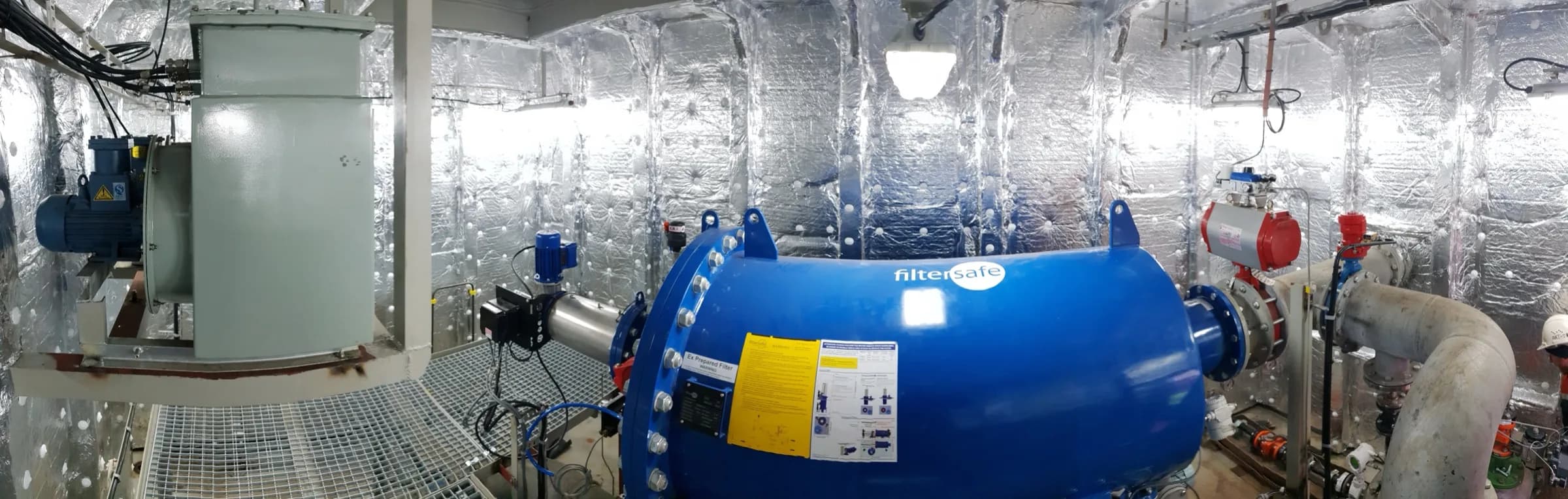
Invasive species carried by ships in ballast water from one ecosystem to another are controlled under IMO's Ballast Water Management (BWM) Convention. At İkbal Denizcilik we manage the whole process: selecting the right ballast water treatment system for the vessel, pipeline integration, installation and commissioning.
Scope
01
IMO D-2 and USCG compliance
The systems we install meet both IMO D-2 and USCG standards.
02
Suitable for every ship type
Can be installed on all vessels, from mid-size ships to the largest bulk carriers.
03
Hazardous area flexibility
Solutions that offer flexibility for installation in hazardous areas.
04
Low energy, long service life
User-friendly automation designed around low energy consumption and long service life.
A short history of ballast water management systems
In 1903 scientists first found mass occurrences of the Asian phytoplankton alga Odontella (Biddulphia sinensis) in the North Sea. This was accepted as one of the first signs that alien species were being carried from one environment to another, although the scientific community did not study the issue in detail until the 1970s. In the late 1980s Canada and Australia, both struggling with invasive species, brought their concerns to IMO's Marine Environment Protection Committee (MEPC).
Today the spread of invasive species is recognised as one of the greatest ecological and economic threats to our planet. These species seriously damage biodiversity, their direct and indirect health effects are growing, and they often leave irreversible damage in the environment.
Adoption of the BWM Convention
At the 26th session of MEPC in September 1988, Canada submitted a report on its concerns about alien microorganisms in ballast water discharged from ships into the Great Lakes; the United States shared similar concerns. After more than 14 years of negotiations between IMO member states, the International Convention for the Control and Management of Ships' Ballast Water and Sediments (BWM Convention) was adopted unanimously at a Diplomatic Conference held at IMO Headquarters in London on 13 February 2004.
“Our duty is to leave a clean world to our children and to their children.”
Treatment standards under the IMO BWM Convention
The Convention's standards fall under two main headings: regulation D-1 covers ballast water exchange standards, while regulation D-2 focuses on ballast water treatment performance.
Ballast water exchange is based on the principle that organisms and pathogens taken up near the coast cannot survive when discharged in the open sea because of differences in temperature, salinity and chemical composition. The exchange is carried out while the ship is in deep ocean waters, and at least 95% of the ballast capacity must be exchanged. The accepted methods are the Sequential, Flow-through and Dilution methods.
However, exchange methods create operational difficulties and are not enough to fully prevent the spread of aquatic organisms. For this reason the Convention requires ships to switch to treatment systems that meet the D-2 standard according to a schedule based on their year of build and ballast capacity. Ships built before 2009 must meet D-2 requirements at the first Intermediate or Special Survey following their anniversary date.
Since 21 June 2012, ships calling at US ports have been required to have a USCG-approved ballast water treatment (BWT) system. Alternatively, the system must hold an IMO type approval certificate, or ballast water of drinking water quality must be obtained from the US.
What do ballast water treatment systems do?
The many ballast water treatment systems approved to date use UV radiation, electrolysis, chemical dosing, gas injection and similar methods. Filters coupled to the system handle large organisms and particles. Most systems treat the water both when it is taken into the tank and when it is discharged.
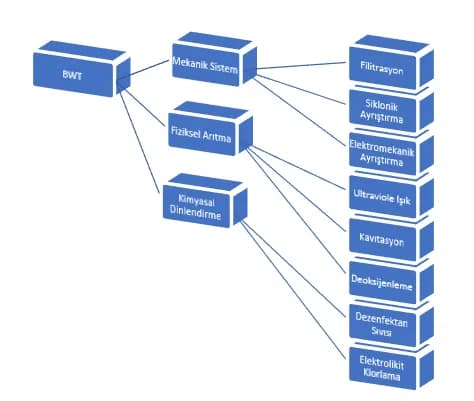
Mechanical systems
- Filtration
- Sediment and particles are separated by disc and screen filters during ballast uptake. Filters are usually self-cleaning by back-flushing; filter resistance and the cleaning cycle can cause pressure drop and reduced flow.
- Cyclonic separation
- Solid particles are separated from the water by centrifugal force; only particles denser than seawater can be separated.
- Electro-mechanical separation
- A flocculent injected into the water binds to organisms and sediment; solid particles are then removed by magnetic separation and filtration.
Physical treatment
- Ultraviolet light
- UV radiation either kills the organism directly or prevents it from reproducing by damaging its cell membrane. Its effectiveness depends on the turbidity of the water; high sediment concentrations can limit the penetration of UV rays.
- Cavitation
- High-energy bubbles generated by venturi tubes or slotted plates neutralise organisms through hydrodynamic force and ultrasonic vibration.
- Deoxygenation
- Dissolved oxygen is removed from the water or replaced with nitrogen or an inert gas. Besides destroying organisms, it also reduces corrosion when kept at the right level; however, the process can take a long time.
Chemical treatment
- Disinfectant liquids
- Disinfectants added to the incoming water during ballast uptake destroy organisms by chemical poisoning or oxidation. Typical biocides are chlorine, chloride ions, chlorine dioxide, sodium hypochlorite and ozone; residues may need to be neutralised.
- Electrolytic chlorination
- An electric current applied to ballast water flowing through an electrolytic cell produces free chlorine, sodium hypochlorite and hydroxyl radicals; electrochemical oxidation is achieved through the formation of ozone and hydrogen peroxide. The method is limited to water within certain salinity levels.
System operating diagram: filtration and retention
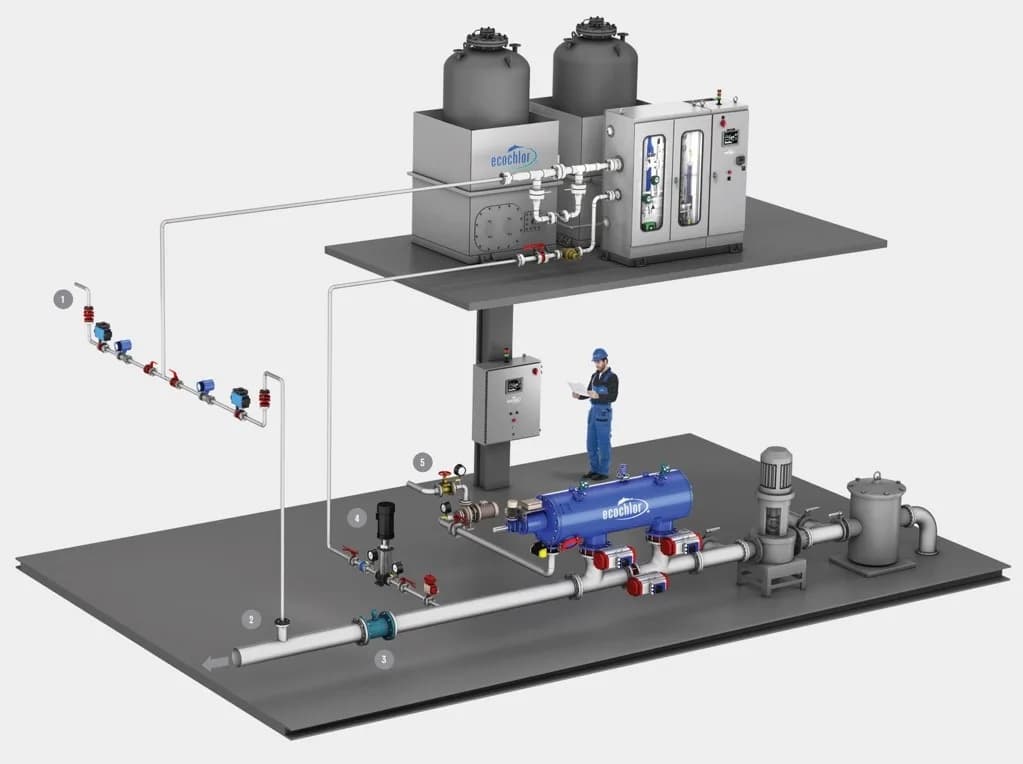
The filtration unit separates sediment and large organisms, while the chlorine dioxide retention system destroys smaller organisms and pathogens. The filter is placed as close as possible to the ballast pump; the retention unit can be installed at any desired location on board.
- Neutralises zooplankton, phytoplankton, algae, microorganisms, pathogens and viruses regardless of turbulence, salinity and temperature.
- Meets both IMO D-2 and USCG standards.
- Can be installed on any vessel, from mid-size ships to the largest bulk carriers.
- Offers flexibility for installation in hazardous areas.
- Ranks highly on cost-efficiency and performance.
Our other services
Let's plan your vessel's next job together
Our team will get back to you as soon as possible for survey, quotation and planning.